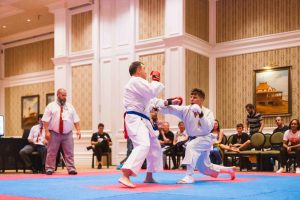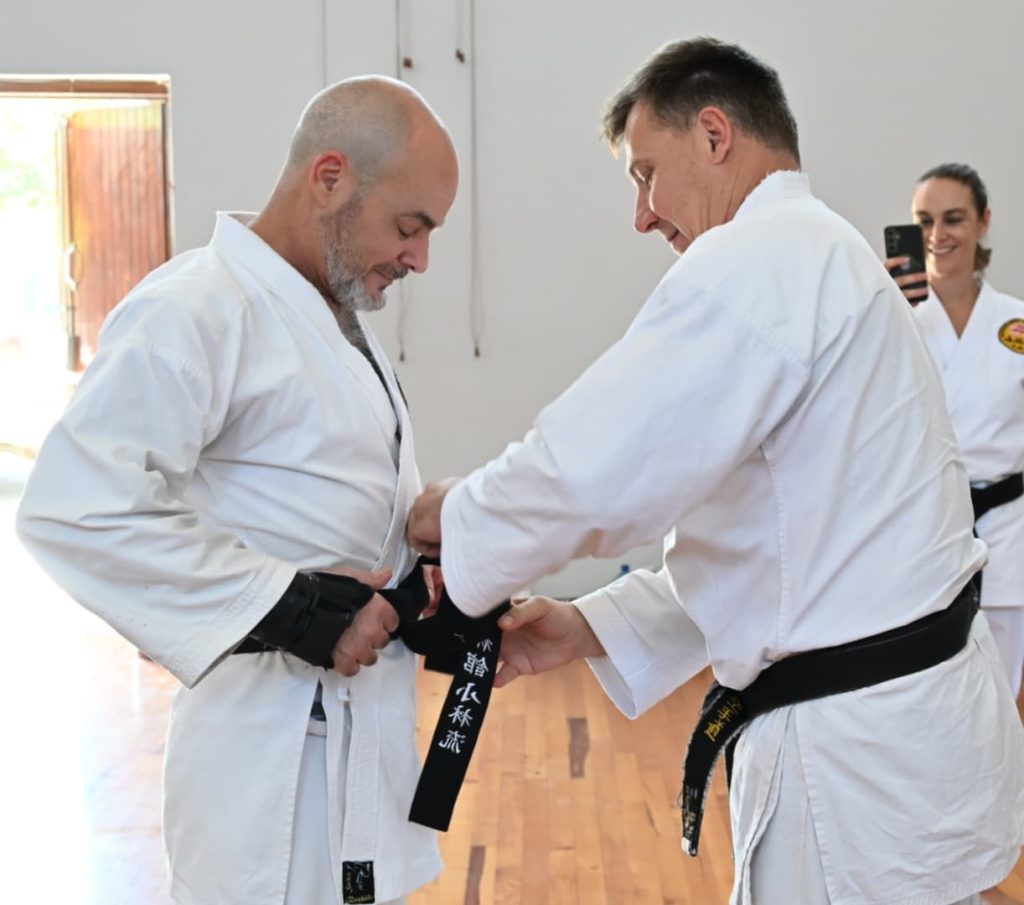
For most karateka, achieving a black belt in Karate is one of the defining moments of their lives. I remember clearly how that transition felt, not as an end point, but as the beginning of something far deeper. The pursuit of black belt is often driven by ambition and determination. But once it is earned, karate changes. You begin to appreciate it more. You start to understand the mechanics behind the movement, the purpose behind the kata, the subtle details in timing, posture, and distance. What once felt difficult becomes instinctive. What once felt technical becomes intuitive.
At black belt level, you are no longer simply proficient. You are capable.
And that is precisely why the responsibility becomes greater.
Karate is not merely a sport. It is not just points, trophies, or gradings. At its core, it is a system of combat. It teaches you how to hurt, disable, and if pushed to the extreme, even kill an opponent. That reality should humble every serious practitioner. By the time a karateka reaches black belt and the title of Sensei they should feel the weight of that responsibility.
Humility is not optional at this level. You do not need to boast about your skill. Your conduct should speak for you. Experience teaches us something else as well: there is always someone more skilled, more experienced, faster, stronger, or wiser. There is always an opponent who can defeat you. Understanding that truth keeps arrogance in check and growth alive.
One of the greatest lessons I have learned is that teaching accelerates learning. A good instructor learns more from teaching than from being taught. You will learn from every student, including White Belts. Their questions force clarity. Their mistakes refine your explanation. Their progress sharpens your observation. Teaching is not a one-way transfer of knowledge; it is a shared journey.
A mature karateka also understands that karate is one of many martial arts systems. No single style is superior to another. It is the teacher and the student who make a style effective. Training with other disciplines reveals an important truth: the fundamentals are remarkably similar. A strong and stable stance matters everywhere. Timing, balance, distance, and structure are universal principles.
Cross-training also exposes both the strengths and weaknesses of karate when facing an opponent with different skill sets. It highlights the defence gaps and gives us the opportunity to fill them. Many bunkai within karate kata clearly draw from the applications found in arts such as Judo, Jujutsu, and Aikido, amongst others. At a very high level, the distinctions between martial arts begin to blur. There is an optimal way to punch, block, throw, kick, sweep, and break joints and bones. Different systems may begin with different foundations, but at their peak, the techniques converge toward the same efficiency and effectiveness.
To become a Sensei is therefore both a privilege and a burden. You are entrusted with knowledge that can cause harm — and with the responsibility to cultivate character alongside skill. Enjoy the journey. Appreciate what you know. Remain humble about what you do not. And pass your knowledge on with diligence and respect for the generations of Senseis who walked the path before you.
That, to me, is the true honour of teaching karate.
For more information contact Sensei Graeme Lund on 082 556 4043 or graeme@toradojo.co.za